CW: discussion of rape, sexual assault, BDSM, rough/violent sex, porn
I have been avoiding writing this post for a while, but in the wake of recent events, I believe it is finally time to bear the discomfort.
Last week, text messages between members of Cornell’s Chi Phi fraternity went viral for depicting the casual language in which college-aged men allegedly discussed drugging and gang-raping a female student. The case has sparked national outrage not only for the messages themselves, but because of the lack of legal consequence the perpetrators received for their actions. Instead of jail time, they were made to write essays, like elementary-aged children and not full-fledged adult males committing felonies.
Perhaps this crime has been particularly devastating for us to learn of because it was recently committed by college-aged men. In essence, it feels as if all of the work society has done to decrease sexual violence has been for nothing. Young generations of men are still casually raping women and apparently not being punished for it.
In order to understand why rape continues to perpetuate Western society, I am writing a series of essays analyzing the sexual and spiritual climates within the US. In this first essay, I am going to review the harmful nature of modern beliefs surrounding sex and kink. In the next essay, we will break down a spiritual analysis of sexual intercourse. Then, we will discuss how the spiritual state of individuals, as well as Western society itself, is mirrored in rape and paraphilia.
I want to acknowledge that it is taboo to utilize spirituality to explain social phenomena. Instead, we have made use of academically-accepted logics like psychology, history, and sociology as methods of understanding human behavior. However, while all of these tools are helpful, I would argue that they can help perpetuate the mindset that we, as individuals, are powerless and separate from the forces that enable these transgressions.
While the content of these essays are heavy, I hope they offer a theme that is thought-provoking and socially constructive. I believe that every reader has the ability to take part in intrapersonal reflection that can serve to improve the spiritual state of society. Ultimately, this is the primary work necessary to change the behavior of future generations. Everything else is merely a band-aid.
Modern Beliefs: “Casual Sex”
For context, I’m a Gen Z female, and this essay is written from the perspective of someone who actively participates in contemporary heteronormative dating culture. My discussion of sex and gender primarily centers on the experiences of cisgender men and women and the dynamics of heterosexual dating. At the same time, some of the broader cultural dynamics explored in this essay may also intersect with the experiences of transgender, nonbinary, genderqueer, and LGBTQ+ individuals. I also acknowledge that broad claims about an entire generation can never be wholly representative, as no generation is a monolithic group. Rather, this essay offers a perspective informed by recurring themes and patterns I have observed within my own experiences and social sphere.
With this being said, I believe the one thing most Gen Z can agree upon is the casual nature in which we take part in sex. Now, it’s not like this is the first time in human history that humans have engaged in casual sex. The spectrum of having sex before marriage to “one night stands” has created scandal for hundreds of years. However, dating apps have objectively made “casual sex” much more efficient, accessible, and compulsory. A process that once required face-to-face social interaction has been reduced to a series of scanning online applications for your next fuck buddy.
The sheer easiness of casual sex has normalized it to a baseline dating experience. So normal, in fact, that Gen Z is now clueless as to what a healthy sexual timeline should actually look like. Is it three dates? Three weeks? Three months? Should they be my boyfriend first? Or do they need to have sex with me before asking to be my boyfriend? If you attempt to find guidance online, or within social circles, you’re met with the same politically correct vibe: “Girl, it’s up to you! Whatever feels good to you! Everybody’s different!”
Of course, the flooding of modern media with “sex positivity” has been a crucial social advancement, especially for women, who for the brunt of human history have had to guiltily and dangerously internalize sexual experience. Sex positivity has resulted in life-saving healthcare and educational opportunities for millions of people, freeing women from centuries of secret-keeping, abuse, and shame. But, as Carl Jung argues, every integration of opposites begins with an overcorrection. In our attempts to liberate females from their cages of sexual oppression, we have mistakenly “freed” an entire generation into deep water during shark season: unprotected, clueless, and floundering.

Great. Now what do I do about the sharks?
Erm… whatever you want! You go girl!
I want to believe in the idyllic reality where every female is completely in-tune with her own physicality and sexuality, giving her the ability to healthily make sexual decisions with absolutely no mentorship or guidance. Unfortunately, however, women’s pleasure has been programmed to prioritize the pleasure of those around them. We are first and foremost wired to fulfill external expectations, whether those be intimate or societal, most of the time prioritizing them over our own inherent instinct. In other words, sexually mentoring an entire generation with the advice of “do whatever feels good” would be productive if the environment was also conducive to a female actually knowing what feels good. But, we’re living in a society that detaches us from instinct as early as possible, instead filling us with values that objectify women as pawns of patriarchal construct. Thus, “whatever feels good,” whether we realize it or not, is often whatever feels good for men.
As we’ve learned throughout history, liberation without guidance is just a more deceitful form of oppression. By enabling a free-for-all mindset surrounding women’s relationship with sex, we have fundamentally abandoned each other to male-driven influence. As women have excitedly attempted to reclaim their sexual autonomy, we’ve done so in the only way we know how: like men.
Having Sex Like Men: Biological Background
Let’s review some science. The male is biologically wired to maximize his number of sexual partners. Their hormonal pathways literally encourage them to displace their virtually infinite amount of reproductive resources into a variety of people. Did you know that the hormones released during orgasm actively function to emotionally detach a man from his sexual partner, whereas a woman’s function to attach her? (If this interests you, watch this TedTalk: https://www.youtube.com/watch?v=eyq2Wo4eUDg)
In other words, the shark cannot help that it is a shark.
To clarify, I am by no means using this information to justify or withdraw accountability from a man’s poor, and especially not criminal, behavior. Human beings are animals, but they are also conscious souls with free will and morality. Instead, I am using this information to highlight the reasoning behind the sexes’ innately different approaches to sex. A woman, born with all of the eggs she will ever have, is biologically wired to be extremely discerning with her sexual partners. According to the primal and ancient framework of her body, mating with the wrong person could result in devastating physical consequences: that is, being pregnant without support. The same is simply not true for a man.
Because of this reality, there are inherent biological guardrails in place to deter females from participating in casual sex. Even if a woman is having “safe sex,” or utilizing condoms to protect her from pregnancy and STDs, there are negative consequences for her body. The more sex a woman has with different partners, the more dysregulated the pH of her reproductive system becomes, increasing the likelihood of common yet debilitating infections such as UTIs, yeast infections, and bacterial vaginosis (BV). If a man participates in “safe” casual sex, it is comparatively rare that he deals with similar repercussions. These opposing realities are so obvious that women often feel as if they are being “punished” for having sex. Perhaps we are not being punished by our bodies, but having a conversation with them.
Of course, there is the matter of hormonal birth control. Quite frankly, my take on hormonal birth control requires its own essay, but I think it is necessary to mention while reviewing what modern sex culture requires of the female body. Generally, the casual nature in which physicians and sexual partners assume that sexually active women should be on hormones is devastating. I don’t wish to unnecessarily polarize my audience on this topic, so I will reserve it for another piece, but I do think the fact that our sexual culture requires hormonal alteration of the female species is a forthright sign that something is deeply out of alignment with our best interest.
In addition to the physical dysregulation that women experience from casual sex, let’s briefly focus on the taboo, perhaps even more debilitating, consequence: emotional dysregulation. Fortunately or unfortunately, the hormones released during sexual arousal and orgasm for a woman serve to psychologically attach her to her sexual partner. The act of having sex with a person who is not perceived as an emotionally safe and dependable partner is fundamentally disruptive for the female’s nervous system. Her primal psychology doesn’t have a method to separate casual sex from abandonment. Thus, whether or not the woman feels cognitively okay with the prospect, her body is systematically programmed to process it as a traumatic event.
Basically, at the crux of this scientific argument is the following: no positive social environment is ever going to induce a reality in which the female body can comfortably and extensively participate in casual sex. As casual sex increasingly becomes the baseline for modern dating, I worry that females will begin to pathologize the discomfort and havoc that it wreaks within their bodies. Instead of recognizing that this “norm” is actually not a “norm” at all, women will find ways to blame their individual psychologies for their inability to cope. Perhaps terms that have already entered the conversation like “anxious attachment” and “borderline” are merely concepts we’ve developed to understand the dysregulation we experience in a male-centered society.
In essence, we’ve equated sexual liberation with the ability to freely mimic male sexual behavior, but this reality has the potential to be fundamentally harmful and disservicing to females. Like other things, I believe we’ve been fooled to view our sexual freedom through a patriarchal—and thus inherently misogynistic—lens. I challenge women to question and rethink what sexual autonomy would actually look like if it was thoroughly aligned with female biology and psychology.
Modern Beliefs: Kink
In this section, I want to observe the modern “sex-positive” views on kink. Kink is defined as “any sexual or intimate interest, practice, or fantasy that falls outside of conventional or ‘vanilla’ norms.” Of course, kinks are endless in their variety, ranging from fantasy role play to foot fetishes. However, the main paraphilia that comes to mind when considering kink is typically BDSM (bondage, discipline/dominance, submission/sadism, and masochism). The goal of this section is to examine the normalization of BDSM in young adults. Although it is my understanding that BDSM is nuanced and not always mutually inclusive with rough sex, for the sake of this section, I will consider them to be synonymous.
From Fifty Shades of Grey to Rihanna’s “S&M,” BDSM and rough sex has become normalized within modern culture. When Rihanna’s “S&M” hit #2 on Billboard in 2011, I was nine years old, ignorantly singing along with her on the radio:
It’s disturbing to consider that I was being desensitized to the idea of aggressive sex through the media before I even understood the mechanics of sex itself. However, I got off lucky, considering some of my peers began viewing aggressive porn by that age, and even earlier. We will examine porn more deeply in a bit.
BDSM, a specific framework for psychologically and physically aggressive sex, has become protected within modern sex culture. The main defense for this is the fact that people taking part in BDSM, which has the potential to remarkably resemble sexual assault and rape, are doing so consensually. The qualifier of “consent” when regarding kink is extremely important, as it has become a means to condone and normalize aggressive sex behaviors and preferences. The sex positivity movement has gone so far as to produce the concept of “kink-shaming,” which attempts to prohibit the act of questioning or criticizing a person’s consensual kinks.
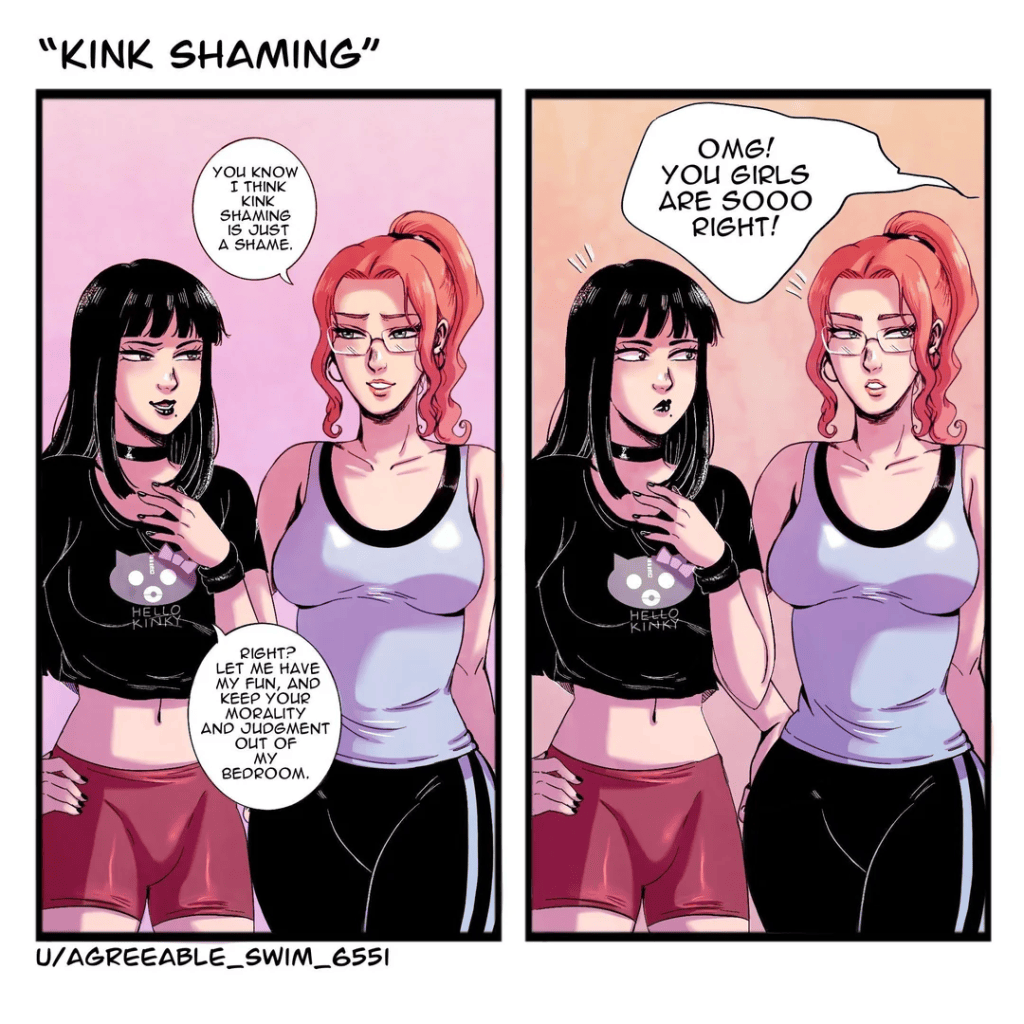
In the heteronormative realm, rough sex is sexual intercourse that includes elements traditionally painful to the female, including but not limited to: choking, slapping, hitting, spanking, hair pulling, and painful penetration. In today’s sexual climate, rough sex is more normalized than it ever has been. It’s so normalized, that even reading this article, you’re probably like, okay, chill out, prude! Can’t we all just have a good time?
The answer is, quite frankly, not anymore. By participating in violent sex, even consensually, we are actively engaging in a culture where sexual violence is normalized and condoned.
This may seem like an extreme argument, and relative to the desensitizing media that we consume everyday, it is. Certainly, there is a spectrum of aggression in sexual activity, and even primary literature on rough sex distinguishes between differences like “spanked them lightly” and “spanked hard enough to leave a mark.” Obviously, discernment of what is “violent” is personal, and the purpose of this essay isn’t to tell you how to have sex. I’m merely and uncomfortably proposing analysis of why we desire to engage in pain-causing behaviors during sex. By writing off rough sex as a shallow pleasure that doesn’t partake in the violent sexual culture we inhabit, we are enabling the exact market that condones and profits from the sexual abuse of children and females.
This act of enabling includes having rough sex as well as viewing porn that portrays rough sex. Our access to porn is a primary cause of society’s desensitization to violent sex. It requires plain sense to understand how regular porn viewership increases tolerance to arousal, thus requiring more ‘extreme’ content to achieve orgasm. ‘Extreme’ content most commonly includes rough and violent sex, and unfortunately escalates to content portraying rape and child sexual abuse.
Criticism of the porn industry has only recently become more prevalent in mainstream media. In addition to its devastating consequences of incentivizing human trafficking and sexual abuse, young people have begun to notice other life-ruining effects of porn in their peers. Not only is porn a source of debilitating addiction and cause of increased sexual dysfunction, but it fundamentally changes the way we perceive sex. By increased exposure to content that portrays rough sex, both men and women are beginning to conceive violence as a baseline for intimacy. And, what’s worse is that many are starting to require it for sexual arousal and satisfaction. How can we possibly be surprised at a group of college-aged men raping a female when the likeliness of them viewing violent porn and even participating in violent sex prior to that point is extremely high? This event is sickening and devastating, but surprising? If we, as a society, are actively surprised at this event given the current sexual climate, then I believe it’s high time we turn a critical lens toward young people’s indulgent attitude surrounding sex and kink.
To be clear, I am not arguing that we rewind fifty years to a time of sexual shame, secrets, or even “modesty.” I am not arguing that we stop talking about sex, and I am certainly not arguing that it is females’ fault men engage in disgusting behavior. I am suggesting that in society’s attempts to sexually liberate itself, we have eliminated boundaries where they are absolutely necessary. There are reasons that substances like opiates must be highly controlled, and for those same reasons, we must openly reintegrate a higher sense of moral discernment surrounding casual sex and kink.
Call to Action: Talk About It
Here is a list of uncomfortable, albeit pressing, questions both men and women should start asking ourselves, our friends, and our sexual partners:
- Do I watch porn? Is it necessary for me to watch porn?
- Does the porn I watch portray rough/violent sex?
- Why do I enjoy rough/violent sex?
- Why do I enjoy being hurt during sex?
- Why do I enjoy hurting others during sex?
- How do the kinks I have normalize sexual violence?
- What other media do I consume that actively desensitizes me to violence, sex, or violent sex? (movies, TV shows, short-form content, books, true crime content, etc)
- Why is it okay for me to participate in sex culture that disrespects the dignity of females?
- In what ways does the current sex culture increase the likelihood of sexual assault and rape?
Casual sex questions that are deserving of sincere consideration:
- Is it easier or more likely for me to have rough/violent sex with casual sex partners? Why?
- If I could cultivate my very own sex culture, how long would I prefer to know someone before having sex with them? What would the sex be like?
- What would female-centered sex culture look like in the ideal world?
- In what ways do I physically abandon myself in my daily life? How may this carry over into my sexual relationships?
- What does it feel like when I am fully aligned with my body and mind? How can I practice this feeling in my sexual relationships?
Conclusion
In this essay, we examined how modern sex culture continues to be a result of male-dominated influence. We reviewed the unparalleled sacrifices that women make to participate in casual sex. Then, we discussed society’s lack of boundaries when permitting participation in violent sex culture through kink or porn, and how consequential normalization of these behaviors may increase the likelihood of sexual assault. To cultivate a society where female autonomy and dignity is truly respected, honored, and valued, a thorough understanding of these dynamics is crucial. Conversations with inquiries like the ones above are a way that we can increase awareness of harmful elements of modern sex culture and begin to implement change.
In my next essay, we will be discussing the spiritual component of sex, and how neglect of it contributes to the abuse and paraphilia prevalent in Western sex culture.
Best,
Lucks


Leave a comment